Key Takeaways
A strong video production ad begins well before the camera rolls. Clear goals, a focused concept, efficient production, and platform-aware editing give the final commercial a better chance to earn attention and support growth.
- Define the business result and audience before developing the creative.
- Build one clear idea around a useful message, story, or offer.
- Plan the shoot carefully so every scene serves the edit.
- Create versions that suit each platform and viewing context.
- Use performance data to improve the next production.
Define the strategy before production begins
A commercial is easier to make when everyone understands what it needs to accomplish. Start with the business objective, the audience, and the action you want viewers to take. This strategic foundation keeps creative decisions connected to measurable outcomes rather than personal taste. For a broader planning perspective, this video marketing strategy guide offers a useful way to connect production choices with business goals.
Set campaign goals and measurable KPIs
Choose one primary goal for the campaign, such as increasing awareness, generating qualified visits, collecting leads, or supporting sales. Then select indicators that reflect that goal instead of treating every available metric as equally meaningful. A reach campaign may prioritize completed views and frequency, while a conversion campaign may focus on clicks, qualified inquiries, and return on ad spend. A clear measurement plan also gives the creative team a practical standard for judging whether the ad is working.
Identify the target audience and customer journey
A video should speak to a particular viewer at a particular point in the decision process. Map what that person already knows, what concern may hold them back, and what evidence could move them forward. Someone discovering a brand may need a memorable promise, while a warmer prospect may respond better to proof, a demonstration, or a direct offer. This distinction affects the script, visuals, pacing, and call to action.
Choose the right advertising platforms
The platform should follow the viewing situation, not the other way around. Consider whether people will encounter the ad while scrolling, searching, watching longer content, visiting a website, or attending a streamed event. Each setting changes the ideal opening, aspect ratio, duration, caption treatment, and level of explanation. A useful commercial concept can travel across channels, but it should not be copied blindly from one placement to another.
Establish the budget, timeline, and production scope
Set the available budget against the number of locations, shooting days, performers, deliverables, and revisions required. A smaller scope can still look intentional when the concept is focused and the production plan is realistic. Build time for approvals, location checks, sound checks, editing, captions, and platform exports. The schedule should protect the moments that carry the message rather than spending every resource on surface polish.
Develop a concept that supports the brand
The strongest concepts make the brand easier to understand, remember, and trust. They do not try to say everything at once. Instead, they select one meaningful tension, benefit, or point of view and express it through a visual idea viewers can follow quickly. The result should feel like a natural extension of the brand, not a disconnected piece of entertainment.

Turn the brand message into a clear creative brief
A useful brief answers a few practical questions: who is the viewer, what do they need, what should they feel, and what should they do next? Add the single-minded message, supporting proof, tone, visual references, required brand elements, and delivery formats. Keep the brief short enough to guide decisions on set. VG Creations describes its approach as strategic video content that builds trust, strengthens authority, and supports measurable business results, a useful example of how a production partner can begin with purpose rather than equipment.
Choose a compelling story, offer, or emotional hook
The hook may be a relatable problem, a surprising observation, a customer moment, a transformation, or a clearly framed offer. It needs to create an immediate reason to keep watching without making a promise the brand cannot support. Once attention is earned, the story should move naturally toward the product, service, or brand idea. Emotional appeal works best when it is anchored in a concrete human situation.
Match the visual style to the brand identity
Visual decisions communicate before the voiceover begins. Decide whether the ad should feel intimate, energetic, precise, warm, premium, documentary-led, or playful, then carry that choice through lighting, framing, color, locations, wardrobe, and movement. Consistency matters more than ornament. A restrained visual system can make a message feel credible, while an overly dramatic style may undermine a serious subject.
Plan the call to action and next step
The call to action should be the logical continuation of the story. Ask viewers to take one clear step, such as visiting a landing page, booking a conversation, requesting information, or learning more. Make the destination match the promise made in the ad so the transition feels easy. If the campaign serves different levels of intent, prepare distinct calls to action rather than forcing one message to do every job.
Write a video ad script that converts
A script for advertising is a blueprint for attention and action, not simply a spoken sales pitch. It must work with images, sound, performance, pacing, and the viewer’s limited attention. Write for the ear, but also indicate what the audience sees at each important beat. Reading the script aloud often reveals vague language and slow openings before they become expensive production problems.
Structure the opening hook for immediate attention
The first seconds should introduce a question, tension, image, or statement that feels relevant to the intended viewer. Avoid beginning with unnecessary greetings or background information. The opening does not need to explain the whole offer; it needs to earn the next moment. Test several hooks on paper and choose the one that most directly connects the audience’s situation to the ad’s central idea.
Communicate the problem and solution clearly
Once attention is secured, establish the problem in language the audience recognizes. Then show how the product, service, or brand changes that situation. Keep the sequence easy to follow: challenge, response, benefit, and next step. Specific details are more persuasive than broad claims, but every detail must be accurate and support the campaign goal.
Use dialogue, narration, and on-screen text effectively
Each communication layer should add something rather than repeat the same sentence. Dialogue can bring personality and credibility, narration can connect scenes, and on-screen text can reinforce a key phrase for viewers watching without sound. Keep text brief and legible, with enough contrast and screen time to be understood. The visual action should remain meaningful even when the spoken words are removed.
Keep the message concise for different ad formats
Write the master idea first, then create shorter versions with their own rhythm. A fifteen-second cut cannot simply be a longer commercial chopped at random; it needs a complete hook and a clear reason to act. Plan cutdowns, alternate openings, and end cards during scripting so the shoot captures what the edits will require. This approach reduces frantic revisions later.
Plan the shoot for quality and efficiency
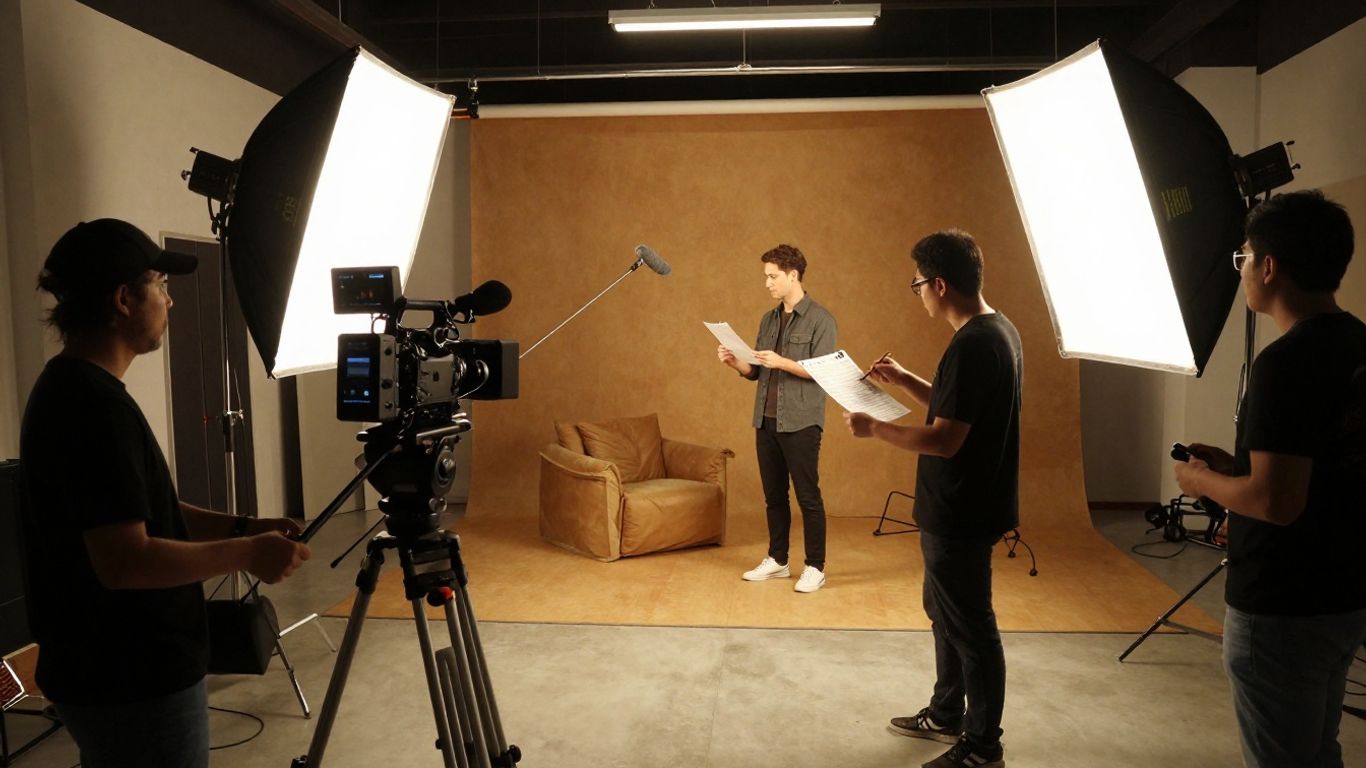
Good production planning protects both creative quality and the budget. Every location, setup, prop, and performance should have a reason to exist in the final edit. A practical plan also leaves room for small discoveries on set without losing control of the day. The more clearly the team understands the priority shots, the more confidently it can adapt when conditions change.
Build a practical shot list and production schedule
Translate the script into a shot list that identifies framing, movement, action, dialogue, sound needs, and priority. Group shots by location and lighting setup to reduce unnecessary resets. Include establishing images, close details, transitions, reactions, and clean plates where they may help the edit. The schedule should distinguish essential shots from useful extras so the team knows what cannot be missed.
Select locations, talent, props, and wardrobe
Choose locations that support the story while remaining manageable for sound, access, power, parking, and permissions. Talent should fit the audience and be comfortable performing the required action, whether that means delivering dialogue or behaving naturally on camera. Props and wardrobe need to reinforce the brand without distracting from the message. Confirm continuity details before the shoot rather than relying on memory.
Prepare lighting, sound, and camera requirements
The technical plan should match the intended mood and delivery formats. Decide how the team will control natural light, record clean dialogue, monitor sound, and maintain consistent exposure and color between setups. Check camera movement, lenses, frame rates, storage, batteries, and backup procedures in advance. Production value comes from thoughtful control, not from adding gear without a clear purpose.
Account for legal permissions and brand safety
Secure location releases, talent agreements, music rights, artwork permissions, and any approvals required for visible products or claims. Review the script for promises that need substantiation and imagery that could create privacy or safety concerns. Keep records organized so the final ad can be distributed confidently. This preparation is especially valuable when one shoot will produce multiple versions for paid media and owned channels.
Produce footage that captures attention
The shoot is where the strategy becomes visible and audible. Attention comes from a combination of performance, composition, timing, texture, and sound rather than from any single camera trick. Direct each choice back to what the viewer needs to notice or feel. A polished frame that does not serve the message is still a wasted frame.
Direct talent for natural and persuasive performances
Give performers a clear objective instead of asking them to sound enthusiastic in the abstract. Explain who they are speaking to, what has just happened, and what they want the viewer to understand. Capture several approaches, including restrained, conversational, and more energetic versions. Natural delivery usually comes from a clear circumstance and relaxed repetition, not from forcing a perfect take immediately.
Use composition and movement to guide viewer focus
Arrange the frame so the eye lands on the important subject first. Lines, contrast, depth, foreground elements, and controlled movement can direct attention without competing with the message. Camera movement should have a reason, whether it reveals information, follows action, or creates intimacy. If everything moves or changes at once, the viewer may remember the motion but miss the point.
Record clean audio and consistent visuals
Poor sound can make an otherwise attractive ad feel unreliable. Monitor dialogue throughout the shoot, record room tone, and watch for traffic, machinery, clothing noise, and inconsistent microphone placement. Keep exposure, white balance, and screen direction consistent across related shots. These details give the editor flexibility and help the finished commercial feel like one coherent piece.
Capture alternate shots for multiple ad versions
Use the shoot to gather variations that can support testing later. Record different openings, reactions, product details, lengths of pauses, calls to action, and framing options when practical. The aim is not to create random excess, but to preserve meaningful editorial choices. VG Creations offers commercial videos, social media content, and video editing services, so planning adaptable footage can help a production serve more than one marketing use.
Edit the video production ad for each platform
Editing turns the captured material into an argument with a beginning, middle, and end. It also adapts that argument to the way people encounter the ad. A strong edit removes anything that delays understanding, while preserving enough texture for the brand to feel human. Review every cut for clarity, pace, sound, accessibility, and the action the viewer is meant to take.
Create versions for social media, websites, and television
Begin with the campaign’s central idea, then build versions around the requirements of each placement. Social cuts may need faster visual changes and an immediate hook, while a website video may have more room to establish context. Television, connected viewing, and event screens bring different distances, sound conditions, and attention patterns. Keep the message recognizable across versions without making every edit identical.
Optimize aspect ratios, length, captions, and thumbnails
Prepare vertical, square, and horizontal compositions when the media plan calls for them. Check that faces, products, logos, and captions remain inside safe areas after reframing. The opening frame and thumbnail should communicate a clear reason to watch, not merely display a decorative image. Confirm duration, file specifications, and compression before delivery.
Use music, sound design, graphics, and color grading
Music can establish pace and feeling, while sound design gives actions weight and helps transitions feel intentional. Graphics should clarify information rather than cover the frame with decoration. Color grading should create consistency and support the brand’s visual character across locations. VG Creations positions post-production services as a way to elevate the feeling of videos and brands so they resonate with audiences and stand out.
Add subtitles and make the ad accessible without sound
Assume that some viewers will encounter the commercial in a quiet public place or with audio turned off. Use accurate subtitles, readable sizing, sufficient contrast, and sensible timing. Describe essential sound cues visually when they carry meaning, and avoid placing text over important action. Accessibility is not only a compliance consideration; it also protects comprehension in ordinary viewing conditions.
Measure performance and improve future campaigns
The first release is a source of evidence, not a final judgment on the brand or the production team. Give the ad enough time and delivery to produce useful data, then compare results against the original objective. Separate creative performance from audience, placement, budget, and frequency effects where possible. The aim is to learn which message and execution deserve another investment.
Track views, engagement, clicks, conversions, and return on ad spend
Choose a small reporting set that matches the funnel stage. View-through behavior can show whether the opening holds attention, while click quality and conversion data reveal whether the promise leads to meaningful action. Track cost alongside volume so a high number of views does not disguise weak efficiency. Add qualitative observations from comments, sales conversations, or customer questions when they reveal confusion the dashboard cannot explain.
Compare creative variations through A/B testing
Test one meaningful difference at a time when possible, such as the opening hook, visual order, presenter, offer, or call to action. Keep the audience, placement, and measurement window consistent enough for the comparison to be useful. A single shoot can support several strategically different versions, but each version should have a clear hypothesis. Results become more valuable when the team records what it expected to happen before launch.
Identify audience drop-off and delivery issues
Look for the points where viewers stop watching and compare those moments with the edit. A drop before the offer may indicate a weak opening or slow explanation, while strong completion with few clicks may suggest a mismatched call to action or landing page. Also check frequency, placement, loading, caption errors, and delivery constraints before blaming the concept. Data needs context to become a production decision.
Repurpose high-performing footage across marketing channels
Useful footage can continue working after the original ad run. Extract short clips, still frames, testimonial moments, behind-the-scenes material, website sections, sales enablement assets, or event content when the rights and context allow. Keep each adaptation tied to a specific audience and purpose. A thoughtful content library extends the value of one production without pretending that every cut belongs everywhere.
| Performance signal |
What it may indicate |
Practical next step |
| Low early retention |
The hook or opening image lacks relevance |
Test a sharper first beat |
| Strong views, few clicks |
The offer or next step is unclear |
Revise the call to action |
| Strong clicks, weak conversions |
The landing experience does not match the ad |
Align page promise and proof |
| Uneven results by placement |
The format or context needs adaptation |
Re-edit for the best placements |
This kind of review keeps reporting connected to action. Rather than chasing a single impressive number, the team can decide whether to change the script, the edit, the media setup, or the destination after each learning cycle.
Conclusion
A video production ad drives brand growth when strategy and craft stay connected from the first brief through the final report. Define the audience and outcome, build a focused concept, plan the shoot carefully, edit for the real viewing environment, and use performance evidence to make the next version better. That process creates commercials that do more than look polished: they give people a clear reason to trust, remember, and respond to the brand.
Frequently Asked Questions
What is a video production ad?
A video production ad is a commercial created to communicate a brand, product, service, or offer and encourage a defined audience to take a next step. It combines creative planning, scripting, filming, editing, and distribution.
How long should a commercial video be?
The ideal length depends on the platform, audience, goal, and complexity of the message. Short versions need a complete hook and action, while longer versions may have more room for context and proof.
What should a video ad include?
Most effective ads include a relevant opening, a clear audience problem or desire, a credible response, a memorable brand connection, and one understandable call to action. The exact balance varies by campaign stage.
How much does commercial video production cost?
Cost depends on the concept, number of shooting days, locations, talent, crew, equipment, post-production, and number of final versions. Defining scope early makes estimates more useful and reduces avoidable changes.
Should one commercial be used on every platform?
The central idea can remain consistent, but the edit should usually adapt to each platform’s aspect ratio, duration, sound environment, caption needs, and viewer behavior. Platform-specific versions are often easier to understand and test.
How can a video ad be made accessible without sound?
Use accurate subtitles, readable on-screen text, strong visual storytelling, and clear contrast. Make sure essential information is not communicated only through dialogue or music.
Which metrics matter most for a video ad?
The most useful metrics depend on the campaign goal. Awareness campaigns may emphasize reach and completed views, while performance campaigns may prioritize qualified clicks, conversions, acquisition cost, and return on ad spend.