Key Takeaways
The right production partner starts with a clear business purpose, not a camera package. Use the following principles to compare video production firms with a practical eye.
- Define the audience, channel, and action you want the video to support.
- Match the production team’s services and portfolio to your actual project.
- Ask how strategy, logistics, approvals, and revisions will be handled.
- Compare complete project value rather than estimates in isolation.
- Choose a partner that communicates clearly and treats video as a long-term asset.
Define your video goals and audience
A strong production search begins before you contact a studio. Decide what the video needs to accomplish, who should care about it, and where it will be viewed. This gives prospective partners enough context to recommend an appropriate approach instead of offering a generic package. A useful video production selection guide can help organize those early questions.
Match the video format to your marketing objective
Different formats solve different problems. A testimonial can build confidence, a corporate video can explain an organization, and event coverage can extend the life of a gathering beyond the room. A commercial may need a sharper sales message, while a podcast or interview can create a deeper connection over time.
Start with the desired action: book a consultation, attend an event, understand a service, apply for a role, or remember a brand. The objective should influence length, tone, structure, and the amount of production complexity you actually need.
Identify the audience, platform, and viewing context
A video watched silently on a phone needs a different opening and caption strategy than one shown to a conference audience. Consider whether viewers already know your brand, how much time they have, and whether they are researching, comparing, or ready to act.
Audience research can also involve studying the content environment around your topic. For example, pages about employee exit assessments, Maui wedding questions, or focus supplement comparisons each imply different viewer needs, expectations, and decision stages. The point is not to copy their formats; it is to notice how context changes the way information should be presented.
Set success metrics before production begins
Agree on a small set of measures before filming. Depending on the objective, these might include qualified inquiries, registrations, watch time, completion rate, landing-page visits, or sales-team usage. A production firm can create a beautiful video, but it cannot define meaningful success without knowing what the business needs from the asset.
Write down the baseline, reporting window, distribution channels, and owner for each metric. That simple record makes the final review more useful and helps distinguish a creative preference from a business result.
Compare the services video production firms offer
Production companies vary widely in how much of the work they handle. Some focus on filming, while others guide strategy, develop the concept, coordinate the shoot, and deliver multiple finished assets. Ask what is included and what would require another vendor. The best fit depends on your project’s scope, internal resources, and appetite for managing details.
Full-service production from concept to delivery
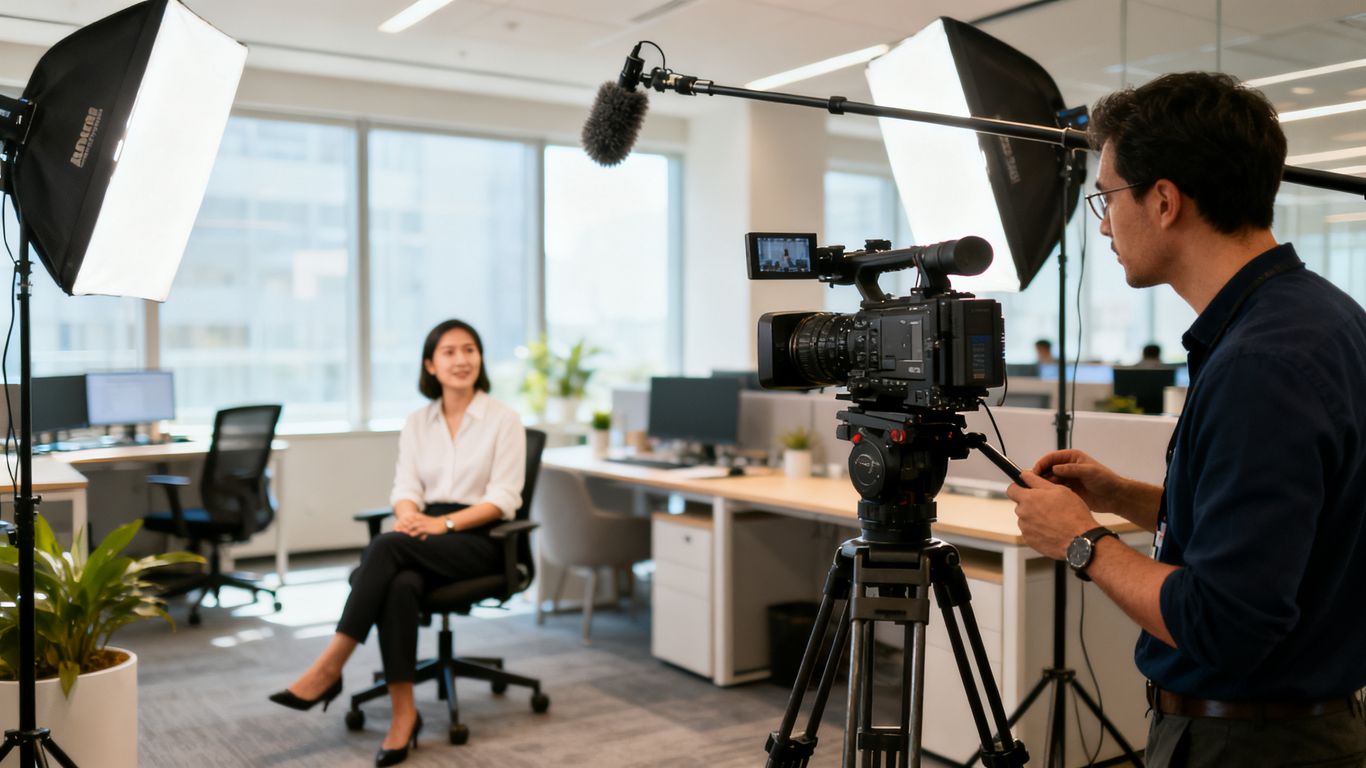
A full-service team may be useful when you want one accountable partner across planning, filming, and post-production. Confirm whether the proposed team covers creative development, scripting, casting, location planning, camera and audio, editing, color, sound, graphics, and delivery. “Full service” should describe a working relationship, not just a broad label on a website.
Ask who will be responsible for each stage and which specialists will be assigned. That clarity prevents gaps between a creative idea and its practical execution.
Specialized formats such as commercials and corporate videos
Review whether the firm has made the type of content your audience expects to see. Commercials often require concise messaging and a strong visual hook; corporate videos may need interviews, workplace footage, and a careful explanation of the organization. Training, healthcare, financial, and legal content may also demand extra attention to accuracy and approvals.
VG Creations lists corporate videos and commercial videos among its videography offerings, so a relevant conversation should focus on your intended audience, message, and distribution rather than assuming every project needs the same treatment.
Event, interview, and testimonial video capabilities
Event work calls for anticipation, mobility, and dependable audio in changing conditions. Interviews and testimonials require a director or producer who can help people feel comfortable while still drawing out specific, credible answers. Ask to see examples with a similar pace, venue, speaker profile, or emotional register.
A capable firm should also explain how it handles permissions, releases, backup recording, and the possibility that important moments happen only once. Those details matter as much as the final camera movement.
Video editing, podcast production, and live streaming support
Editing, podcast production, and live streaming involve different technical pressures, even when they share equipment and creative skills. Ask whether the team can manage the recording environment, audio workflow, graphics, platform requirements, and delivery schedule for the format you have in mind.
VG Creations describes podcast production as covering setup through post-production and also lists live streaming and video editing services. If those capabilities match your needs, ask for a specific workflow and deliverable list before treating them as part of the estimate.
Evaluate creative quality and production expertise
A portfolio is more revealing when you study it for decisions rather than polish alone. Look at how stories begin, how people are framed, how sound supports the message, and whether the work feels appropriate for the intended audience. A production firm should be able to explain why it made those choices.
Review portfolios for relevant industries and styles
A broad reel can demonstrate range, but individual case examples show how a team solves real communication problems. Search for work that resembles your industry, audience, location, and distribution plan. If you are producing a healthcare explainer, a product film may show technical skill but not necessarily the right interview or compliance instincts.
Compare several projects for consistency. One impressive sequence is less useful than evidence that the team can repeatedly deliver clear, well-structured work.
Assess storytelling, cinematography, and brand alignment
Technical quality includes lighting, composition, camera movement, image consistency, and clean sound. Storytelling asks a different question: does the viewer understand what matters and why? The strongest work makes those elements serve the brand instead of allowing visual style to become the message.
Look for a visual identity that feels intentional without forcing every project into the same template. Creative alignment matters because a technically excellent video can still feel wrong if its tone conflicts with the brand.
Look for experience with healthcare, e-commerce, and events
Industry experience is useful when it reflects genuine familiarity with the audience and production conditions. Healthcare projects may involve sensitive subjects and several reviewers. E-commerce work may need product detail, demonstrations, or multiple cutdowns. Event projects require fast decisions, location awareness, and a plan for unpredictable moments.
Ask what the team learned from comparable projects, not merely whether a category appears in its portfolio. Specific answers reveal more than a list of logos.
Check the firm’s approach to originality and creative collaboration
Originality does not mean making every idea strange or expensive. It means finding a clear, ownable way to communicate the message while respecting the brand’s character. During a pitch, notice whether the firm asks useful questions, challenges weak assumptions, and gives your team room to contribute.
You can also review a cinematic storytelling resource to see how a production partner might connect creative decisions with brand objectives. The final concept should be understandable enough for stakeholders to approve and distinctive enough for viewers to remember.
Understand the production process
A reliable process makes creative work easier to manage. It turns a loose idea into a sequence of decisions about audience, story, schedule, people, locations, and approvals. Ask each candidate to walk you through a typical project in plain language, including what happens when the plan changes.
Start with discovery, planning, and creative strategy
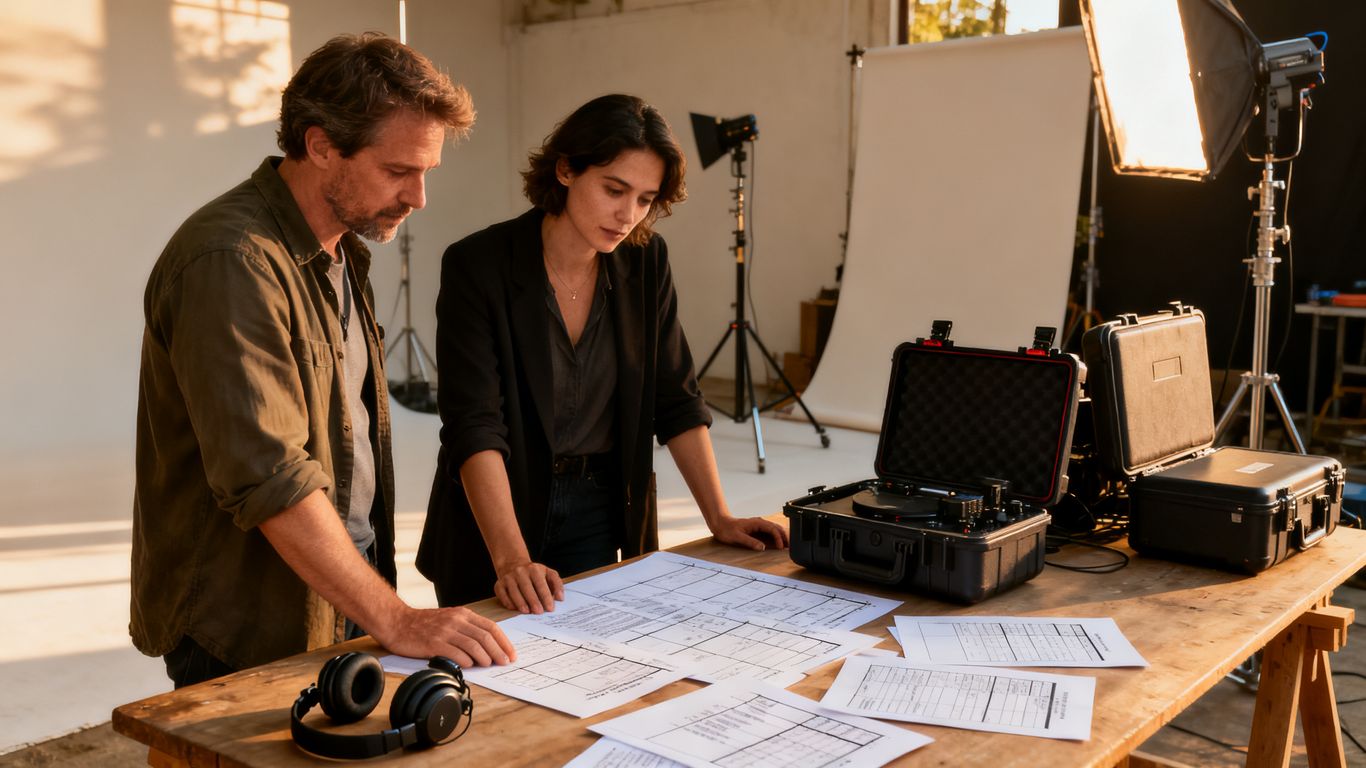
Discovery should establish the business objective, audience, key message, tone, distribution plan, and available resources. It is also the moment to surface constraints, such as executive availability, privacy requirements, venue rules, or a fixed launch date.
A useful partner will turn that conversation into a brief or creative direction that everyone can reference. If the proposal jumps straight to shoot days without explaining the thinking, ask for more detail before proceeding.
Build a practical script and production schedule
The script should be persuasive on the page and realistic to produce. It needs room for natural speech, appropriate visual coverage, and a clear understanding of what must be captured on the day. The schedule should identify dependencies, not just list a start time and an end time.
For a project with several moving parts, use a simple planning sequence:
- Approve the brief, message, and creative direction.
- Confirm script, interview questions, locations, and participants.
- Lock the shoot schedule, call sheet, equipment, and contingency plan.
- Set review dates for the first cut, revisions, and final delivery.
This sequence helps the team identify decisions that could otherwise create a delay. It also gives internal stakeholders a clear role without inviting unlimited late-stage changes.
Coordinate locations, talent, equipment, and logistics
Production logistics can quietly determine whether a project feels calm or chaotic. Confirm who secures permits, coordinates talent, manages releases, arranges access, and handles equipment. For events, ask about audio capture, backup plans, crowd movement, and how the team will work without disrupting attendees.
The more complex the location or schedule, the more valuable a detailed production plan becomes. A short written checklist is often enough to expose an assumption that needs an owner.
Clarify communication, approvals, and revision stages
Before signing, identify the main contact, meeting rhythm, approval authority, review platform, and number of included revision rounds. Define what counts as a revision and what would be treated as a new creative direction. This protects both sides from vague expectations.
A corporate video planning guide can help you prepare questions about process, communication, pricing, and contracts. The goal is a working agreement that keeps feedback focused and lets the creative team move forward.
Compare pricing, timelines, and project value
A low quote is not necessarily economical if it omits essential work or produces an asset that cannot be used across your channels. Compare proposals on scope, assumptions, responsibilities, and deliverables. Ask for enough detail to understand what changes the price.
Understand what the production estimate includes
Look for line items covering creative development, pre-production, crew, equipment, travel, locations, talent, insurance, editing, music licensing, graphics, and delivery. Some firms bundle these costs; others separate them. Either approach can work if the assumptions are visible.
Ask what is excluded, too. Overtime, additional shoot days, rush editing, extra versions, paid talent usage, and major script changes can materially affect the final cost.
Account for pre-production, filming, editing, and distribution
A production estimate should follow the real lifecycle of the project. Pre-production may take more thought than filming, particularly when interviews, locations, or multiple stakeholders are involved. Post-production can include several rounds of editing, audio work, color, captions, graphics, and platform-specific exports.
Use a comparison table to separate scope from price:
| Cost area |
Questions to ask |
Why it matters |
| Pre-production |
Is strategy, scripting, and scheduling included? |
It reduces avoidable shoot-day problems. |
| Filming |
How many crew members, hours, and locations are covered? |
It shows the practical production capacity. |
| Post-production |
Which edits, audio work, graphics, and captions are included? |
It defines the quality and usability of the final asset. |
| Distribution |
Are versions, exports, licensing, or delivery support included? |
It determines how widely the video can be used. |
After comparing these areas, you can see whether a cheaper proposal is truly smaller or simply less specific. That is a more useful conversation than asking only for a discount.
Evaluate turnaround times without sacrificing quality
A fast delivery can be valuable when tied to a launch, event, or campaign. Still, speed should not erase discovery, backup planning, careful editing, or meaningful review time. Ask for milestone dates rather than a single promise of final delivery.
VG Creations presents a streamlined production experience and describes a workflow built around speed, clarity, and ease. If turnaround is a deciding factor, ask how that workflow applies to your particular scope and what tradeoffs, if any, it creates.
Compare projected business value instead of choosing by price alone
Estimate how the video might be reused in sales conversations, landing pages, social content, presentations, recruiting, or event follow-up. A project that creates several useful assets may have greater value than a cheaper single edit with limited reach.
Value is still a projection, not a guarantee. Base it on a realistic distribution plan, a defined audience, and the actions the video is expected to support.
Assess post-production and content distribution
The shoot is only one part of the asset. Editing determines what the audience understands, feels, and remembers, while distribution determines whether the finished work is actually seen. Discuss both before production begins so the team can capture footage and audio that support the intended versions.
Review editing, color grading, sound design, and graphics
Ask how the firm approaches pacing, narrative structure, dialogue cleanup, music, color consistency, captions, and motion graphics. Request to see a rough-cut and final-cut example when possible. The difference between them can reveal how much attention the team gives to refinement.
Good post-production should make the message clearer, not bury it under effects. It should also preserve the brand’s tone across interviews, b-roll, graphics, and sound.
Plan versions for social media, websites, and paid campaigns
One master video rarely fits every channel. Discuss aspect ratios, durations, captions, thumbnails, opening seconds, calls to action, and safe areas for platform interfaces. A distribution plan may call for several cutdowns rather than one long edit.
Ask who writes the accompanying copy and who owns publishing. Even when the production firm only supplies files, it should understand how those files will be used.
Confirm ownership of footage, files, and final deliverables
Your agreement should state who owns the final videos, raw footage, project files, music licenses, graphics, and photography. It should also describe storage, access, archiving, and the period during which revisions are available.
Do not assume that receiving a finished export gives you every underlying asset. Put the expected handoff in writing before the project starts.
Connect video assets to SEO, social media, and sales campaigns
Video works harder when it is connected to the rest of the marketing system. Add transcripts or supporting copy where appropriate, create social cutdowns, give sales teams a clear use case, and track the page or campaign actions that matter. A video marketing strategy guide can help connect production choices with broader brand and campaign goals.
For a more natural beauty topic, for instance, a grass-fed tallow guide or a creatine gummies buying guide would call for a different editorial angle, visual treatment, and audience promise. Those examples reinforce a basic rule: distribution and creative decisions should follow the viewer’s question, not the production team’s favorite style.
Choose a production partner you can trust
The final choice is about working behavior as much as creative ability. You are trusting the partner with deadlines, access to people, sensitive information, and a public expression of the brand. A polished reel cannot compensate for unclear communication or careless preparation.
Verify testimonials, references, and client communication
Read testimonials for specific evidence about collaboration, responsiveness, comfort on camera, editing, and attention to detail. When possible, speak with a reference whose project had a similar scale or timeline. Notice whether the firm answers difficult questions directly and documents next steps.
Client communication should feel structured without becoming rigid. You should know when decisions are needed, who makes them, and how concerns will be handled.
Consider local access and nationwide or worldwide availability
Local access can simplify scouting, travel, permits, and on-site meetings. A team with broader availability may be more practical for distributed offices, conferences, or campaigns in several markets. Consider where the important work will happen, rather than selecting solely by headquarters.
VG Creations identifies Miami and West Palm Beach locations and also states that it is available worldwide. For any production partner, confirm travel arrangements, local crew support, and the level of involvement available outside its home area.
Evaluate professionalism, flexibility, and attention to detail
Look for prompt replies, organized proposals, realistic schedules, and thoughtful questions. Flexibility matters when weather changes, a speaker cancels, or the client discovers a better story during an interview. Professionalism means adapting without losing control of scope or quality.
A brand video planning resource can help you assess scripts, on-camera talent, locations, sound, and measurement before the discovery call. Preparation makes it easier to recognize a partner who is genuinely listening.
Prepare questions for a discovery call and final proposal
Bring a short brief and ask how the team would approach the objective, audience, format, schedule, and distribution. Also ask who will be on set, who edits the work, how feedback is collected, what the revision limits are, and how files are delivered.
Use the call to test the relationship, not just the estimate. You should leave with a clearer understanding of the project and a reasonable next step, even if you ultimately decide not to hire that firm.
Conclusion
Choosing among video production firms becomes much simpler when the decision is anchored in audience, purpose, process, and value. Define the job the video must do, inspect the team’s relevant work, make the scope visible, and choose a partner whose communication gives you confidence from the first conversation through final delivery.
Frequently Asked Questions
How do I choose between local and remote video production firms?
Choose based on the project’s locations, travel needs, collaboration style, and required availability. Local access can simplify logistics, while a remote or distributed team may suit multi-market work.
What should I include in a video production brief?
Include the business objective, audience, key message, preferred format, channels, desired action, schedule, stakeholders, budget range, and any legal or brand requirements.
How much do video production firms typically charge?
Costs vary with crew size, locations, talent, equipment, filming days, post-production, licensing, revisions, and deliverables. Compare complete scopes rather than relying on a headline price.
How long does video production take?
A simple project may move quickly, while interviews, multiple locations, events, or extensive approvals require more time. Ask for milestone dates covering planning, filming, editing, feedback, and delivery.
Should I hire a firm that specializes in my industry?
Relevant experience can shorten the learning curve and improve audience understanding, but it should be evaluated alongside storytelling quality, communication, and the firm’s ability to understand your specific objective.
What deliverables should I request?
Clarify the master video, cutdowns, aspect ratios, captions, thumbnails, graphics, audio files, raw footage, project files, and any platform-ready exports you need.
How can I measure whether a brand video worked?
Choose metrics that match the objective, such as qualified inquiries, registrations, watch time, completion rate, page visits, sales-team usage, or conversions. Establish the measurement plan before publishing.